
Five records an NRS auditor asks for first
A tax audit usually starts with a letter listing documents to send, often within weeks. These five records are nearly always on it, and having them ready makes the audit shorter.
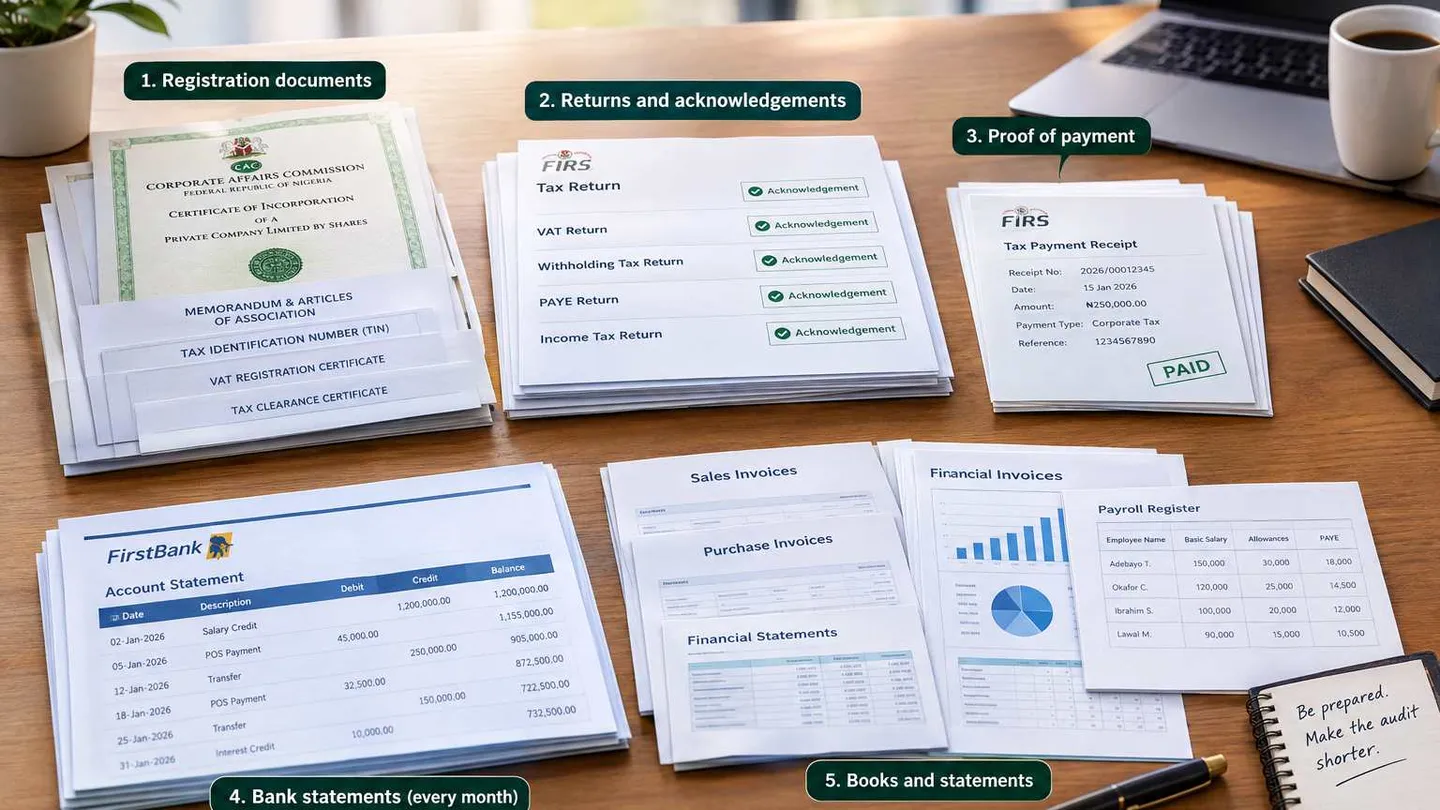
A tax audit rarely starts with questions. It starts with a letter from the Nigeria Revenue Service (NRS) or your state tax office listing documents to send, often within a few weeks. Businesses that answer quickly, with everything in order, usually have a shorter and easier audit. These five records are nearly always on the list.
1. Your registration documents
Your CAC certificate and, for companies, the status report and memorandum and articles of association; your Tax ID; your VAT registration if you're registered; and your latest Tax Clearance Certificate.
2. Every return, with its acknowledgement
All VAT, withholding tax and PAYE returns for the period, and your income tax returns. Keep the acknowledgement for each one: a return without it is hard to prove you filed.
3. Proof that you paid
The payment receipt for every return that showed tax to pay. Tax declared but with no receipt is one of the first things an auditor queries.
4. Bank statements for every month
Auditors compare what went through your bank with what you declared. Missing months are a red flag even when nothing is wrong.
5. Your books, and the statements made from them
Sales and purchase invoices, your financial statements, and if you have staff, the payroll register for each month. The most common query is why a return doesn't match the books: VAT sales that differ from sales in your accounts, or PAYE that differs from the payroll register. Have the explanation ready before you're asked.
How TaxAudit helps
The Documents checklist shows what a business like yours should keep and what's missing. The pre-audit check runs the comparisons an auditor would, ranks what they'd likely query by the money at risk, and builds a sealed audit evidence pack. When a letter does arrive, the audit letters workspace lists each request with the evidence you already hold.
- Registration documents and your Tax Clearance Certificate come first
- Every return needs its acknowledgement, and every payment its receipt
- Bank statements for every month, with no gaps
- Mismatches between returns and books are the most common query
This article is general information, not tax advice.
This article explains the law as at 12 October 2026. It's general guidance, not professional tax advice. Rates and thresholds should be confirmed for your situation.